

Maryam Nawaz Free Transport Service
Maryam Nawaz Free Transport Service Punjab is passing through a difficult economic phase where rising petrol and diesel prices have directly affected the daily lives of common people. For a worker earning a limited income, even a small increase in transport fare creates serious financial pressure. Students, office employees, factory workers, and daily wage laborers are among the most affected groups. In many cases, people are forced to reduce travel or shift to less comfortable options just to manage their expenses.
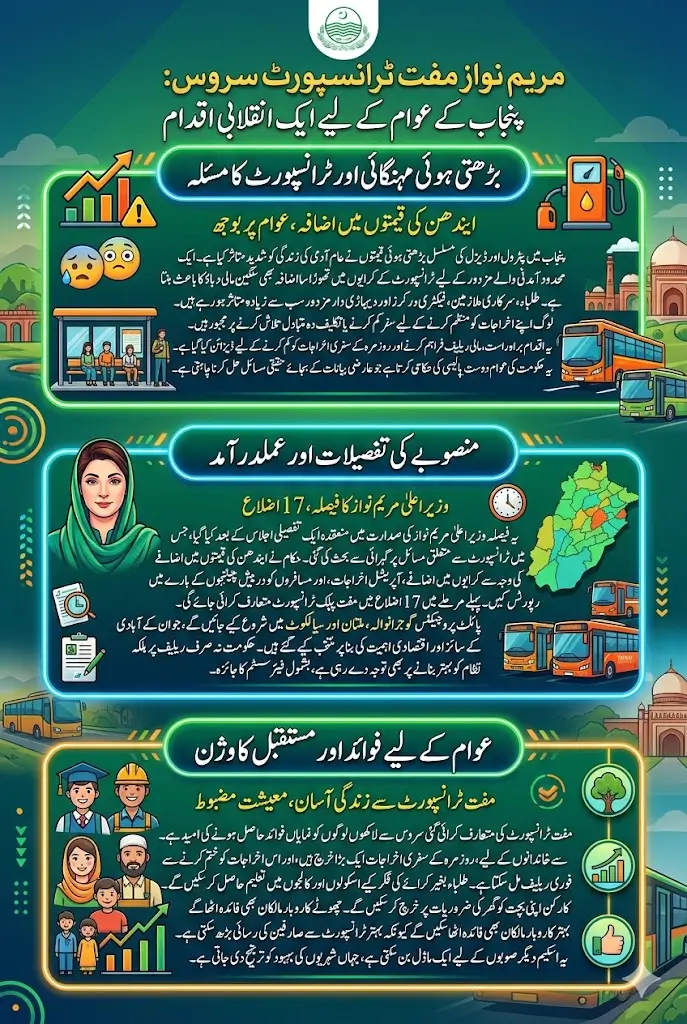
In this situation, the Punjab government under Maryam Nawaz has introduced a major relief step by announcing free public transport in 17 districts. This initiative is designed to directly reduce the daily cost of commuting and provide immediate financial relief. It reflects a people-focused approach where the government is trying to solve real problems faced by citizens instead of offering temporary statements.
This move is also important because it expands the concept of free transport beyond major cities. Earlier, such facilities were limited, but now the government is planning to bring this relief to a wider population. This shows a clear intention to improve public transport accessibility and reduce inequality between urban and semi-urban areas.
You Can Also Read: Sindh Petrol Subsidy Portal Down
Key Decision Taken Under Chief Minister Maryam Nawaz
The announcement was made after a detailed meeting chaired by Maryam Nawaz, where transport-related issues were discussed in depth. Officials presented reports about fare increases, operational costs, and the challenges faced by passengers due to fuel price hikes. The Chief Minister carefully reviewed these factors before approving the expansion of free transport services.
One of the most important instructions given during the meeting was to prepare a report on per-kilometer transport fares within 24 hours. This indicates that the government is not only focusing on relief but also on fixing the system itself. By understanding how fares are calculated, authorities can create a more balanced and fair pricing model.
This decision also reflects strong administrative control and quick policy-making. Instead of delaying action, the government is moving fast to implement solutions. It shows that transport reforms are now becoming a priority area in Punjab’s governance strategy.
You Can Also Read: BISP 8171 Update NADRA Facial Verification
District-Wise Expansion Plan for Free Transport
The plan to introduce free transport in 17 districts is a major development in Punjab’s public service sector. Previously, most modern transport systems were concentrated in big cities like Lahore, leaving smaller districts with limited options. This new initiative aims to change that situation by extending benefits to a broader population.
The inclusion of multiple districts means that people living in less developed areas will also have access to affordable and reliable transport. This can improve their access to jobs, education, and healthcare facilities. It also supports regional development by making movement easier within and between districts.
Key features of the expansion plan include
- Coverage of 17 districts across Punjab to ensure wider reach
- Focus on both urban centers and smaller towns for balanced development
- Special attention to areas where transport facilities are limited
- Step towards equal public service delivery across the province
- Reduction in travel inequality between large cities and smaller regions
This expansion is expected to bring long-term benefits by improving connectivity and supporting economic activity in different parts of Punjab.
You Can Also Read: Solar Policy Pits Govt Against Public Full Details
Pilot Cities Selected for Initial Implementation
To ensure proper execution, the government has decided to start with pilot projects in Gujranwala, Multan, and Sialkot. These cities were selected based on their population size, economic importance, and transport demand. Each of these cities represents a different region and type of urban activity.
Gujranwala is known for its industrial sector, where thousands of workers travel daily. Multan is a major city in South Punjab with a large population and strong commercial activity. Sialkot is internationally recognized for its export industry, making transport an essential part of its daily operations.
Starting with pilot projects allows the government to test the system in real conditions. It helps identify operational challenges, manage passenger flow, and improve service quality before expanding to all 17 districts.
Review of Transport Fare System
Along with launching free transport, the government is also reviewing the existing fare system. This is an important step because many passengers have long complained about unfair fare increases. In many cases, fares go up quickly when fuel prices rise but do not decrease when prices fall.
By analyzing per-kilometer fare data, the government aims to create a transparent and fair pricing structure. This will not only support the free transport initiative but also improve the overall transport system in Punjab.
Expected improvements in the fare system include
- Clear and transparent method for calculating fares
- Better regulation of private transport operators
- Standard pricing across different districts
- Protection of passenger rights against overcharging
- Balanced approach between operator costs and public affordability
These reforms will help build trust between passengers and transport providers, which is essential for long-term success.
You Can Also Read: Punjab CM Easter Grant 2026 New 15,000 PKR
Earlier Free Transport Relief Measures
Before announcing this large-scale plan, the Punjab government had already introduced free travel on several major transport services. These included the Orange Line Metro Train, Metro Bus, Speedo Bus, and Green Electric Buses. This step was taken as an immediate relief measure when fuel prices increased sharply.
The response from the public was positive, as many people benefited from reduced travel costs. Students and workers especially welcomed this initiative because it directly lowered their daily expenses. It also encouraged more people to use public transport instead of private vehicles.
This earlier experience gave the government confidence to expand the program. It showed that free transport is not only possible but also effective in providing real relief to citizens.
Current Free Transport Coverage Overview
The following table shows the major services where free travel has already been implemented and how the new plan is expanding the scope.
| Transport System | Area Covered | Status Before 2026 | Current Status 2026 |
|---|---|---|---|
| Orange Line Train | Lahore | Paid Service | Free |
| Metro Bus | Major Cities | Paid Service | Free |
| Speedo Bus | Urban Routes | Paid Service | Free |
| Green Electric Buses | Selected Areas | Limited Access | Free |
| New District Transport | 17 Districts | Not Available | Expanding Phase |
Comparison with Islamabad Free Transport Model
A similar initiative was introduced in Islamabad, where public transport was made free for 30 days after a sudden increase in fuel prices. This step provided immediate relief to residents and helped control the impact of inflation on daily travel.
However, Punjab’s model appears to be more comprehensive. Instead of limiting the relief to a short period, the provincial government is working on a structured plan that covers multiple districts and aims for long-term benefits. This makes Punjab’s approach more sustainable and impactful.
This comparison highlights how different regions are adopting similar strategies but with varying levels of scale and planning.
You Can Also Read: Maryam Ko Batain Petrol Subsidy Solving Issue
Government Strategy Behind Free Transport Expansion
The main objective behind this initiative is to reduce the financial burden on the public. Transport is a daily necessity, and saving on travel expenses can significantly improve household budgets. The government is also trying to promote public transport as a preferred option over private vehicles.
By increasing the use of buses and trains, the government can reduce traffic congestion and fuel consumption. This not only benefits the economy but also helps the environment.
Key strategic goals of the government include
- Providing direct financial relief to low-income groups
- Encouraging the use of public transport systems
- Reducing dependency on private vehicles
- Improving overall urban mobility
- Supporting economic activity through better connectivity
This strategy shows a balanced approach where short-term relief is combined with long-term planning.
You Can Also Read: Maryam Ko Batain Petrol Subsidy 2026
Expected Benefits for the Public
The introduction of free transport is expected to bring significant benefits for millions of people. For many families, daily commuting costs are a major expense, and removing this cost can provide immediate relief.
Students will be able to attend schools and colleges without worrying about fares. Workers will save money that can be used for household needs. Small business owners will also benefit as improved mobility can increase customer access.
Major benefits include
- Zero daily transport cost for passengers
- Increased access to education and employment opportunities
- Financial savings for low and middle-income families
- Better mobility within cities and districts
- Improved quality of life for citizens
These benefits highlight the importance of this initiative in improving everyday life.
Challenges and Implementation Considerations
Despite its advantages, the free transport plan also faces several challenges. Managing such a large-scale system requires strong planning, funding, and monitoring. One of the biggest concerns is the financial cost of providing free services to millions of passengers.
Another challenge is the possibility of overcrowding. When services become free, more people are likely to use them, which can put pressure on existing infrastructure. Maintaining service quality under increased demand will be crucial.
Key challenges include
- High operational and subsidy costs for the government
- Increased passenger load leading to overcrowding
- Need for better management and monitoring systems
- Risk of misuse or overuse of free services
- Maintaining cleanliness, safety, and punctuality
Addressing these challenges will determine the success of the program.
You Can Also Read: BISP 8171 Government Payment Increase 19500
Future Scope of the Transport Relief Program
Maryam Nawaz Free Transport Service current plan focuses on 17 districts, but there is strong potential for further expansion. If the pilot projects are successful, the government may extend free transport to more areas across Punjab. This could eventually lead to a province-wide system.
There is also a possibility of introducing more eco-friendly transport options such as electric buses. These vehicles can reduce fuel costs and environmental impact, making the system more sustainable in the long run.
This initiative could become a model for other provinces if it is implemented successfully. It represents a new direction in public policy where citizen welfare is given top priority.
Conclusion
Maryam Nawaz Free Transport Service launch of free transport in 17 districts is a major step by the Punjab government to support its citizens during a time of economic pressure. Under the leadership of Maryam Nawaz, this initiative aims to reduce travel costs, improve accessibility, and create a more inclusive transport system.
By combining immediate relief with long-term planning, the government is trying to build a system that benefits everyone. While challenges exist, the potential advantages of this program are significant. If implemented effectively, it can transform the way people travel and set a new standard for public service delivery in Pakistan