

NADRA Announced New B-Form Issuance System
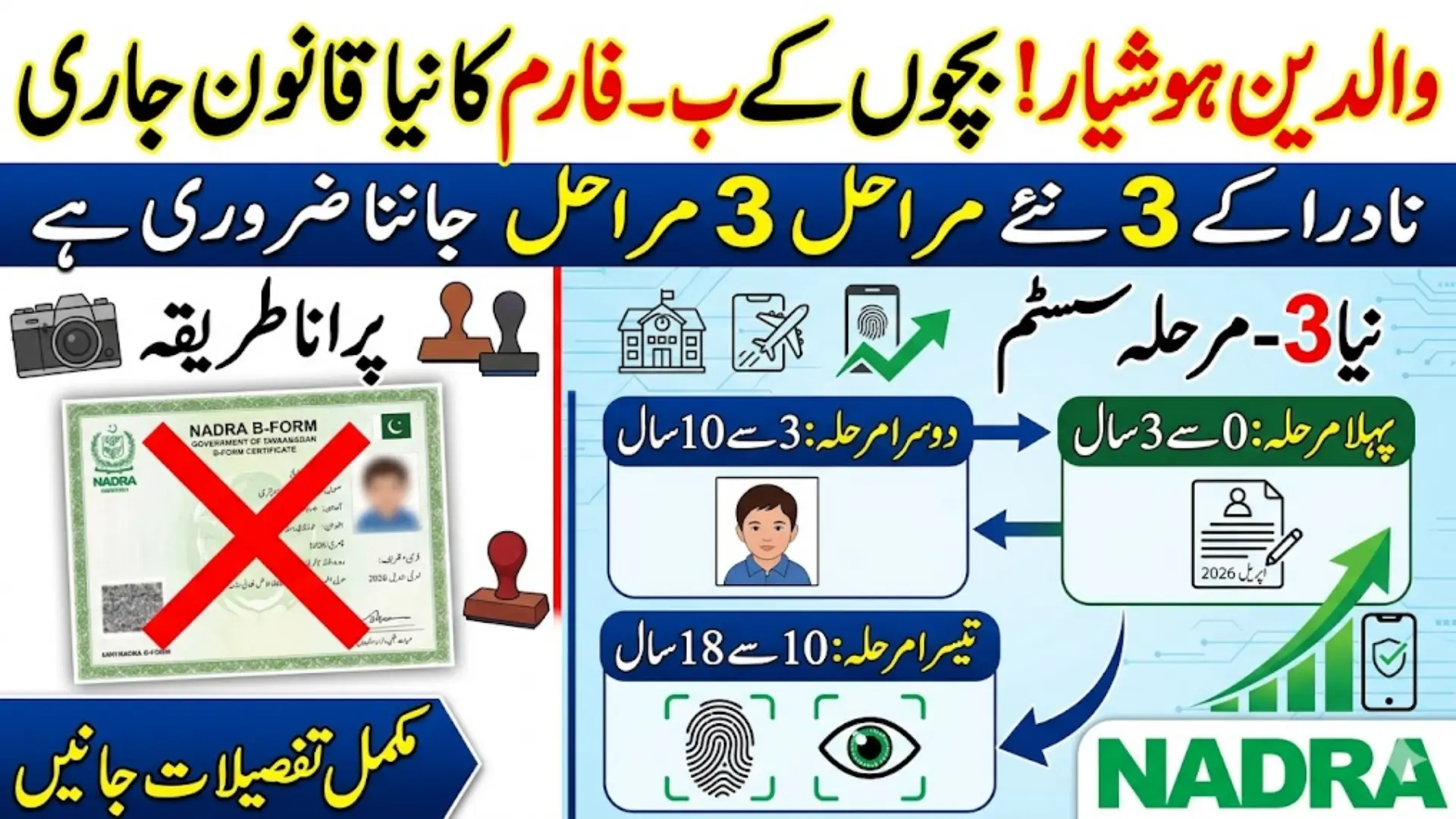
NADRA Announced New B-Form Issuance System National Database and Registration Authority (NADRA) has introduced a major update in the B-Form issuance system, bringing a completely new structure that focuses on age-based identity verification. This change is not just a minor update but a complete shift in how children’s identification records are maintained in Pakistan. Previously, a single B-Form was issued for a long period, which often became outdated as the child grew older and their appearance changed.
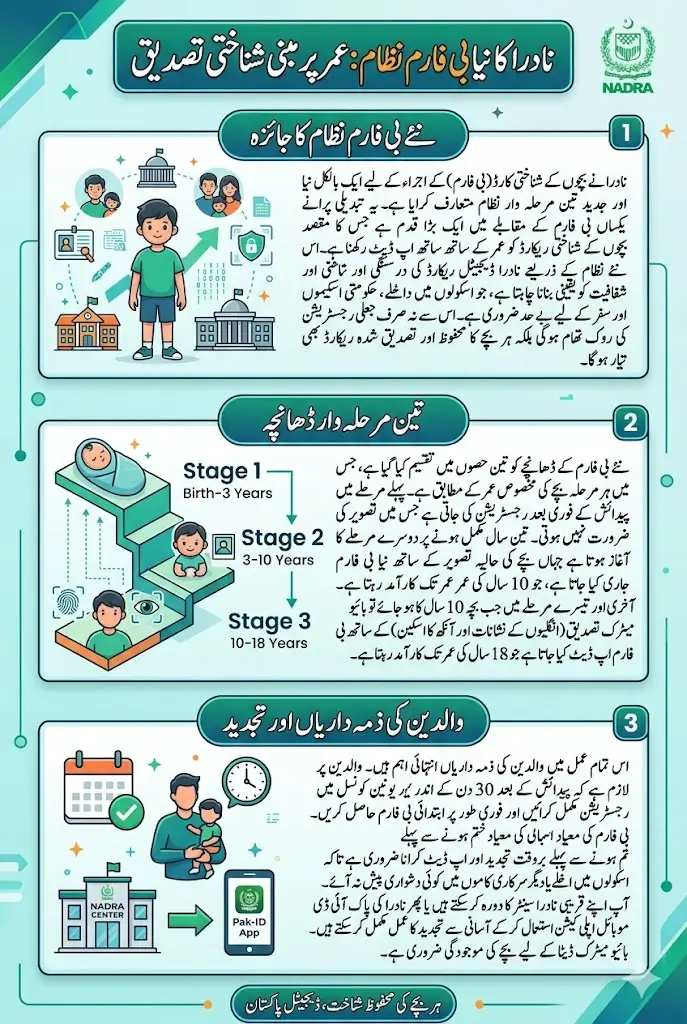
Now, NADRA has taken a practical step by dividing the B-Form into different stages, ensuring that every child’s identity is updated at important points in their life. This approach is more modern and aligns with the growing need for accurate digital records in Pakistan. From school admissions to government schemes and travel requirements, updated identity documents are becoming increasingly important, and this system directly addresses that need.
Another important aspect of this update is that it reflects the government’s focus on improving transparency and reducing identity-related issues. By introducing photographs and biometric verification at later stages, NADRA is strengthening the overall system. This change is especially useful in preventing fake registrations and ensuring that every child has a secure and verified identity record.
You Can Also Read: Petrol Price In Pakistan Today Decrease
Three-Stage B-Form Structure Explained
The newly introduced system is based on a three-stage structure, where each stage corresponds to a specific age group of the child. This step-by-step approach ensures that the information recorded in the national database remains accurate and updated over time. Instead of relying on a single document for many years, parents are now required to renew the B-Form at different stages.
This structured system also makes it easier for authorities to verify identities when needed. For example, a child’s appearance at age two is very different from their appearance at age ten, and the old system failed to reflect such changes. With the new structure, each stage adds more relevant details, making the record stronger and more reliable.
The three-stage structure works as follows:
- First stage focuses on basic registration after birth
- Second stage adds a photograph for better identification
- Third stage introduces biometric data for strong verification
- Each stage has a fixed validity period that must be followed
- Parents are responsible for updating the document on time
Stage One: Birth Registration Without Photograph
At the first stage, the B-Form is issued immediately after the child’s birth. This document serves as the initial entry of the child into the national database. At this point, NADRA does not require a photograph because a newborn’s facial features change rapidly, making early images less useful for long-term identification.
This initial B-Form remains valid until the child reaches the age of three. It is important for parents to understand that this is not a permanent document and must be updated once the validity period ends. Early registration also ensures that the child can easily access future services like school admission and government benefits.
Parents should complete this process as soon as possible by registering the birth at the Union Council within one month. Delays in this step can create complications later, especially when applying for updated documents or other official requirements.
Key points of this stage include:
- Issued at the time of birth
- No photograph is required
- Valid for the first three years
- Acts as the foundation of the child’s identity record
- Requires timely registration at the Union Council
You Can Also Read: PM Fuel Package Beneficiaries Almost 32,000
Stage Two: Updated B-Form With Child Photograph
Once the child turns three years old, the second stage begins. At this point, NADRA requires parents to update the B-Form by including a recent photograph of the child. This step is important because the child’s facial features become more stable and recognizable at this age.
The updated B-Form with a photograph remains valid until the child reaches ten years of age. This document is especially useful for school admissions, where visual identification is often required. It also helps authorities confirm the identity of the child more accurately during different processes.
This stage highlights the importance of keeping records up to date. Many parents in the past ignored updates, which caused issues in verification. With the new system, NADRA has made it clear that timely updates are necessary to maintain an accurate identity record.
Important highlights of this stage:
- Issued after the child turns 3 years old
- Includes a clear photograph of the child
- Valid until 10 years of age
- Helps in school admissions and official verification
- Must be renewed before expiry to avoid issues
You Can Also Read: Today Gold Rate In Pakistan Per Tola April 09
Stage Three: Biometric B-Form for Older Children
The third and final stage starts when the child reaches the age of ten. At this stage, NADRA introduces biometric verification, which includes fingerprints and an iris scan along with the photograph. This makes the B-Form a highly secure document that can be used for advanced identity verification.
This version of the B-Form remains valid until the child turns eighteen. It plays a crucial role in preparing the child for future documentation such as the Computerized National Identity Card (CNIC). By collecting biometric data at this stage, NADRA ensures that the identity record is complete and reliable.
This stage reflects a major advancement in Pakistan’s identity system. Biometric verification is widely used around the world, and its inclusion in the B-Form system shows that NADRA is moving towards modern and secure practices.
This stage includes:
- Photograph for updated visual identification
- Fingerprints for biometric verification
- Iris scan for enhanced security
- Validity until 18 years of age
- Strong foundation for future CNIC issuance
You Can Also Read: New NADRA B-Form Rules 2026 Age-Wise Validity, Photo Requirement
Why NADRA Introduced This New System
The main reason behind introducing this new system is to improve the accuracy and security of identity records in Pakistan. In the past, outdated B-Forms created confusion and made verification difficult, especially when children grew older and their appearance changed significantly.
This updated system ensures that identity records are refreshed at important stages of a child’s life. It also reduces the chances of identity fraud, which has been a concern in many cases. By adding photographs and biometric data, NADRA is making it much harder for fake identities to exist in the system.
Another reason is to support digital governance. As more services move online, having accurate and updated identity records becomes essential. This system helps the government maintain a reliable database that can be used for various public services.
Main reasons for this change include:
- To keep identity records updated with age
- To improve national security and verification
- To reduce fake or duplicate identities
- To support modern digital systems in Pakistan
- To make documentation more reliable and efficient
Responsibilities of Parents After Birth
Parents have a very important role in this entire process. The system can only work effectively if parents follow the guidelines and complete each step on time. The first responsibility is to register the child’s birth at the Union Council within one month, which is a legal requirement in Pakistan.
After obtaining the initial B-Form, parents must also keep track of the validity periods and ensure timely renewal at each stage. Ignoring these updates can lead to problems in school admissions, government schemes, and other official matters.
From practical experience, many families delay these processes, which later creates unnecessary difficulties. NADRA has made the system simple, but it still requires awareness and responsibility from parents.
You Can Also Read: Big Relief for Poor Families Benazir Income Support Program Payment
Parents should ensure the following:
- Register the child’s birth within 30 days
- Obtain the first B-Form without delay
- Keep track of expiry dates
- Update the B-Form at each stage
- Visit NADRA office or use online services when needed
How to Renew B-Form at Each Stage
NADRA has made the renewal process quite simple and accessible for the public. Parents can visit their nearest NADRA registration center along with the child to complete the update process. For stages that require biometric data, the child’s presence is necessary.
In addition to physical visits, NADRA has also introduced the Pak-ID mobile application, which allows users to apply for certain services from home. This is especially helpful for people living in remote areas or those who want to avoid long waiting lines at NADRA offices.
The process generally involves submitting updated information, providing required documents, and completing verification steps. Once approved, the new B-Form is issued according to the child’s age group.
Ways to complete renewal:
- Visit nearest NADRA office with the child
- Provide required documents and details
- Complete biometric verification if required
- Use Pak-ID mobile app for online applications
- Collect updated B-Form after processing
You Can Also Read: United Motorcycles Price Update 2026
Important Timeline Overview
| Age Group | B-Form Type | Key Features | Validity |
|---|---|---|---|
| 0 – 3 Years | Basic B-Form | No photograph | Up to 3 years |
| 3 – 10 Years | Photo B-Form | Includes photograph | Up to 10 years |
| 10 – 18 Years | Biometric B-Form | Photo, fingerprints, iris scan | Up to 18 years |
Final Thoughts
NADRA Announced New B-Form Issuance System This new B-Form system introduced by NADRA is a strong step towards building a more secure and reliable identity system in Pakistan. It ensures that children’s records are not only created but also updated regularly according to their growth and development. This approach solves many problems that existed in the previous system.
For ordinary citizens, especially parents, the message is clear: follow the timeline and keep documents updated. Doing so will not only make future processes easier but also protect the child’s identity in the long run. In today’s digital age, having an accurate and verified identity record is no longer optional, it is a necessity.