

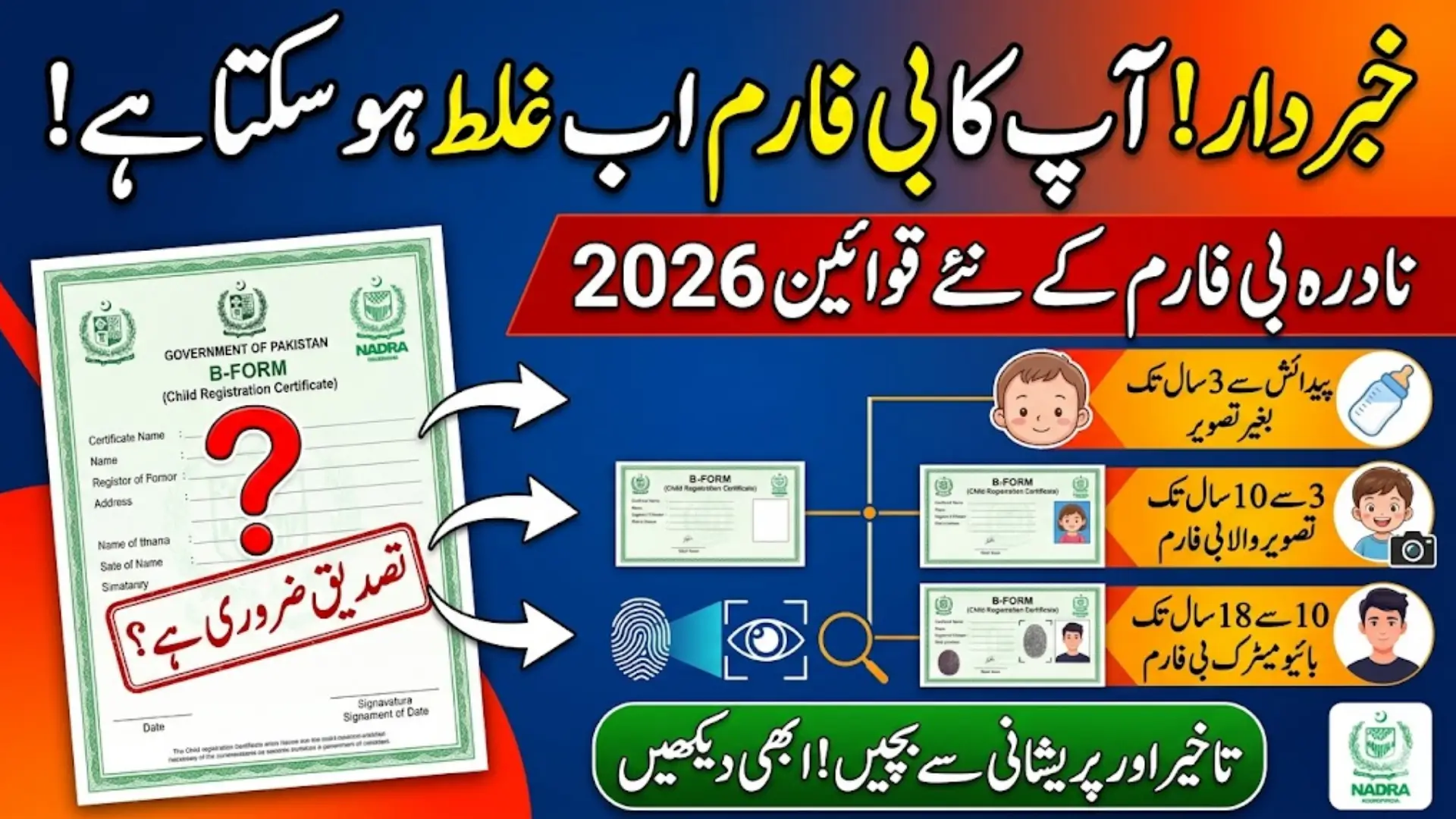
New NADRA B-Form Rules 2026
New NADRA B-Form Rules 2026 In Pakistan, the B-Form (Child Registration Certificate) is not just a simple document; it is the first official identity of a child. Whether it is school admission, applying for a passport, or accessing government services, this document plays a key role in proving a child’s identity. Over the years, many parents treated the B-Form as a one-time process, but the new 2026 rules have changed this approach completely.
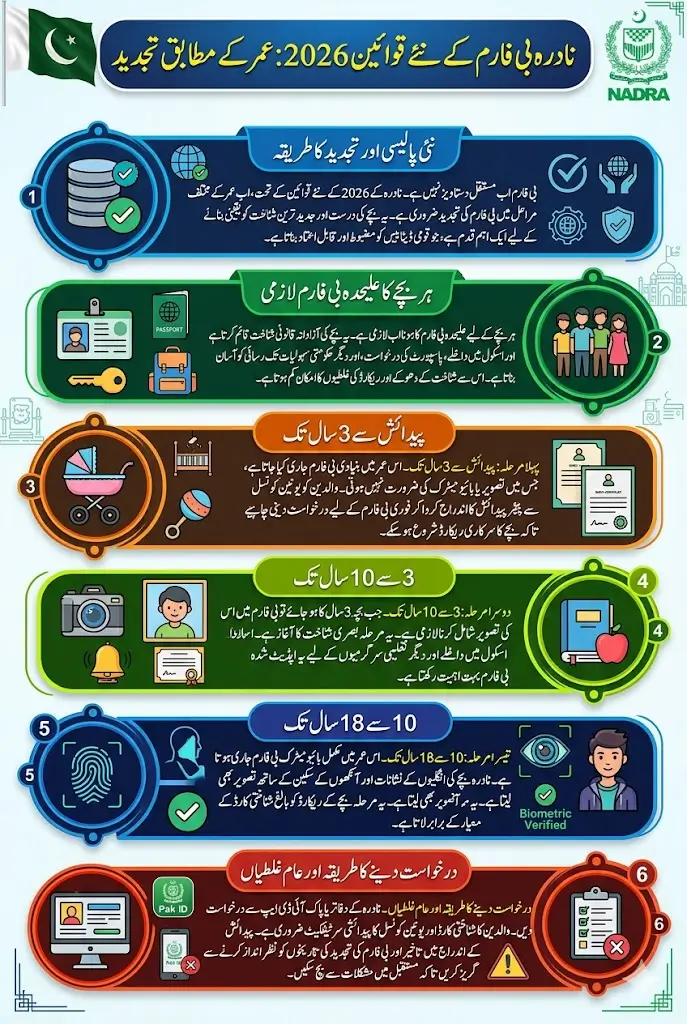
Under the updated system, NADRA has introduced an age-wise validity structure to ensure that a child’s identity record stays accurate and up to date. As children grow, their appearance changes, and their biometric data becomes more stable. That is why the government has made it necessary to update the B-Form at different stages of life. This step is not only important for security but also helps in building a strong and reliable national database.
Why Every Child Needs a Separate B-Form
The concept of issuing a separate B-Form for each child is now strictly implemented. In the past, some families relied mainly on the Family Registration Certificate, but this is no longer enough. Each child must have an individual record in NADRA’s system to ensure proper identification and access to services.
This change is especially important in today’s digital era, where identity verification is required in almost every process. From school admissions to travel documents, having a separate B-Form avoids unnecessary delays and complications. It also protects the child’s legal identity from an early age.
- Ensures each child has an independent legal identity
- Required for school admissions and academic records
- Necessary for passport applications and international travel
- Helps in accessing government schemes and benefits
- Reduces chances of identity fraud or record mismatch
Age-Based B-Form Validity Explained
One of the most important updates in the new policy is the introduction of a fixed validity period based on the child’s age. Instead of issuing a lifetime document, NADRA now requires parents to update the B-Form as the child grows. This approach improves accuracy and ensures that records remain current.
The system is divided into three clear stages. Each stage adds more details to the child’s identity, starting from basic information at birth to full biometric verification in teenage years. This gradual process makes the system more secure and reliable.
| Age Range | Type of B-Form | Key Requirement | Validity Period |
|---|---|---|---|
| Birth to 3 Years | Basic B-Form | No photo required | Valid until age 3 |
| 3 to 10 Years | Photo B-Form | Child’s photograph | Valid until age 10 |
| 10 to 18 Years | Biometric B-Form | Photo, fingerprints, iris | Valid until age 18 |
Stage 1: B-Form Without Photo (Birth to 3 Years)
The first stage begins right after the birth of a child. At this point, parents are required to register the birth at the Union Council and then apply for the B-Form through NADRA. This initial document is issued without a photograph or biometric data because the child is too young for such identification methods.
Although this B-Form may seem simple, it is extremely important because it creates the child’s official record in the national database. Many parents delay this step, but doing so can create complications later when applying for school admission or other documents. It is always better to complete this process as early as possible.
Stage 2: B-Form With Photo (3 to 10 Years)
When the child reaches the age of three, the B-Form must be updated with a photograph. This stage marks the beginning of visual identification in the NADRA system. The child must be present during the application so that a clear and recent photograph can be taken.
This updated B-Form is more widely used in daily life. Schools, academies, and various institutions often require a photo-based identity document. That is why this stage is considered very important for a child’s early education and social activities.
- A fresh photograph of the child is captured
- Previous B-Form is replaced with updated version
- Child’s presence at NADRA office is necessary
- Document becomes more reliable for identification
- Validity continues until the age of 10
Stage 3: Biometric B-Form (10 to 18 Years)
After the age of ten, the B-Form is upgraded once again, this time with full biometric verification. At this stage, NADRA collects the child’s fingerprints, iris scan, and photograph. This process ensures a high level of security and prepares the child for future identity documentation such as CNIC.
This stage is especially important because it aligns the child’s record with adult-level verification standards. It reduces the risk of identity theft and ensures that all future documents are linked correctly.
- Fingerprints are recorded digitally
- Iris scan is conducted for accurate identification
- Updated photograph is included
- Stronger verification system is applied
- Validity extends until the child turns 18
Birth Registration Requirement in Union Council
Before applying for a B-Form, the first and most important step is registering the child’s birth at the local Union Council. According to government rules, this must be done within one month of birth. Without this registration, NADRA cannot process the B-Form application.
Many families in rural and urban areas delay this step due to lack of awareness. However, this delay can cause serious problems later, especially when the child needs official documents. Birth registration is the foundation of a child’s identity and should never be ignored.
How to Apply for a Child B-Form
The process of applying for a B-Form has been made simple so that parents can complete it without difficulty. They can either visit a NADRA registration center or use the Pak ID mobile application from home.
At the NADRA office, the staff guides parents through each step, including form submission and verification. If the application involves a photograph or biometric data, the child must be present at the center. For basic applications, the online method can save time and effort.
- Carry parent’s original CNIC
- Provide child’s birth certificate issued by Union Council
- Ensure child’s presence if photo or biometrics are required
- Verify all information before submission
- Choose between office visit or online application
B-Form Renewal Process After Expiry
Since the new system is based on validity periods, renewing the B-Form at the right time is very important. Each stage has a specific expiry age, and parents must update the document accordingly.
Failure to renew the B-Form on time can lead to issues in school admission, travel documentation, and other official processes. Keeping track of the expiry date and planning ahead can save a lot of trouble.
- Renew at age 3 to add photograph
- Renew at age 10 to add biometric data
- Always update before expiry to avoid delays
- Keep previous documents safe for reference
Apply Through NADRA Office vs Online Method
Today, parents have the convenience of choosing between visiting a NADRA office or applying online through the Pak ID app. Both methods have their own advantages depending on the situation.
If biometric verification is required, visiting the office is necessary. However, for simple updates or renewals, the online method can be very helpful, especially for those who want to avoid long queues.
- NADRA office is الأفضل for biometric verification
- Online method saves travel time and effort
- Both options provide official and secure processing
- Choose based on the type of application
Common Mistakes Parents Should Avoid
While the process may seem straightforward, many parents still make common mistakes that can create unnecessary problems. Being aware of these mistakes can help ensure a smooth experience.
- Delaying birth registration beyond one month
- Ignoring B-Form expiry dates
- Providing incorrect or incomplete information
- Not bringing the child when required
- Skipping biometric updates after age 10
Final Thoughts: Keeping Your Child’s Identity Record Updated
The new NADRA B-Form rules introduced in 2026 are a significant step towards improving Pakistan’s identity system. Although the process now requires updates at different stages, it ultimately benefits both the child and the country by ensuring accurate and secure records.
Parents should treat the B-Form as a long-term responsibility rather than a one-time task. By following the proper steps, meeting deadlines, and keeping records updated, they can ensure that their child faces no difficulties in the future. In today’s world, having correct and complete identity documentation is not just important—it is essential.