
Petrol Price In Pakistan Today Decrease
Petrol Price In Pakistan Today Decrease Fuel prices in Pakistan have always remained a serious concern for the common citizen. In 2026, this concern has become even more intense due to continuous fluctuations in petrol and diesel rates. From daily commuters to business owners, everyone is directly affected when fuel prices go up or down. Over the past few weeks, people have seen both record-high prices and a sudden drop, which has created confusion among the public.

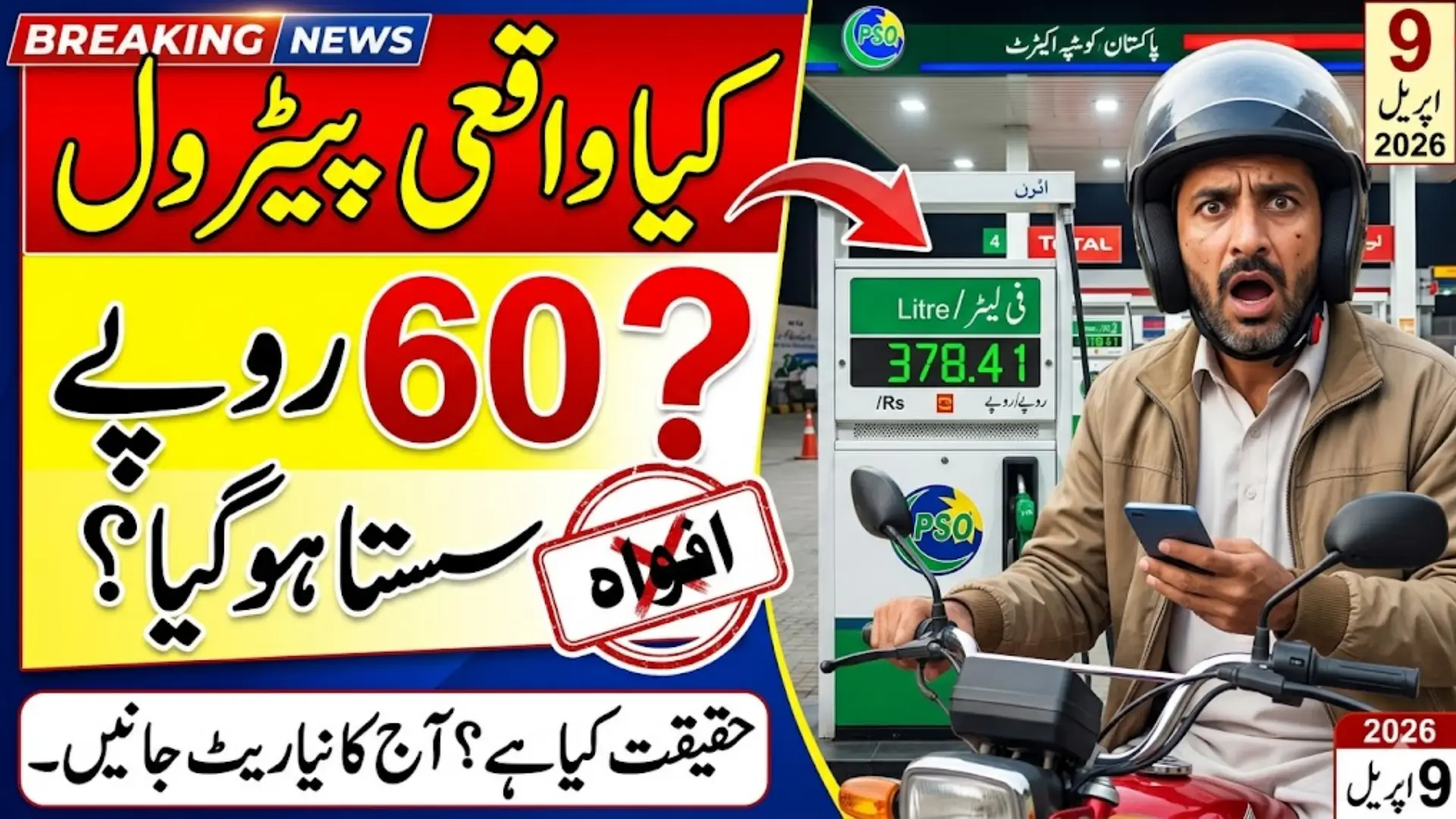
Many people are now searching whether the petrol price in Pakistan has decreased by Rs. 60 per litre today or not. This article explains the complete situation in simple and clear language so that every Pakistani can understand what is really happening. Based on current updates, official data, and market trends, here is the full picture of fuel prices in Pakistan on 09 April 2026.
You Can Also Read: PM Fuel Package Beneficiaries Almost 32,000
Current Petrol Price Update in Pakistan (April 09, 2026)
As of 09 April 2026, the government has decided to keep petrol and diesel prices unchanged after a major reduction earlier in the month. The current petrol price stands at Rs. 378.41 per litre, while high-speed diesel is priced at Rs. 520.35 per litre. This stability has provided temporary relief to the public, especially those who were struggling with rising transportation costs.
In recent days, there has been no official notification regarding any increase or decrease in fuel prices. This means the prices you are paying today are exactly the same as yesterday. The decision to maintain stability shows that authorities are carefully monitoring the global oil market before making any new changes.
Another important aspect is that fuel prices are uniform across Pakistan. Whether you are living in a big city like Karachi or a smaller town, the rates remain the same. This system ensures fairness and avoids regional differences in fuel costs.
You Can Also Read: Today Gold Rate In Pakistan Per Tola April 09
| Fuel Type | Price Per Litre (Rs.) |
|---|---|
| Petrol (Super) | 378.41 |
| High-Speed Diesel | 520.35 |
| Kerosene Oil | 467.48 |
Is Petrol Price Reduced by Rs. 60 Per Litre? Reality Explained
There is a strong buzz on social media and among the public that petrol prices have decreased by Rs. 60 per litre. However, after reviewing official sources and market data, it is clear that no such reduction has been announced on 09 April 2026. This confusion is mainly due to the earlier price cut that already took place at the start of April.
That earlier reduction was quite significant and gave real relief to the public. Because of that, many people are assuming another reduction has happened today. In reality, the government has not issued any new update regarding a fresh decrease.
- No new Rs. 60 reduction announced today
- Current petrol price remains unchanged
- Previous reduction already implemented
- Social media rumors are causing confusion
Understanding this difference is important so that people can rely on accurate information instead of rumors.
You Can Also Read: New NADRA B-Form Rules 2026 Age-Wise Validity, Photo
Comparison Between Previous and Current Fuel Rates
To understand how much relief has actually been provided, it is important to compare previous fuel prices with the current rates. Earlier in 2026, petrol prices had reached around Rs. 458 per litre, which created serious financial pressure on households and businesses.
After the recent reduction, petrol price dropped to Rs. 378.41 per litre. This is a major difference and shows that the government has already provided a significant cut, even if there is no new reduction today.
For many people, especially bike riders and delivery workers, this decrease has made daily travel slightly more affordable. However, diesel prices remain high, which still affects transport and goods delivery costs.
- Previous petrol price: around Rs. 458
- Current petrol price: Rs. 378.41
- Total reduction: approximately Rs. 80
- Diesel price still higher than petrol
Why Petrol Prices Dropped Recently in Pakistan
From a ground-level perspective, the recent drop in petrol prices is not due to a single factor. It is the result of multiple economic and global changes happening at the same time. Pakistan heavily depends on imported oil, so international market trends play a key role.
One of the biggest reasons is the decrease in global crude oil prices. When international prices fall, the cost of importing fuel also decreases. This allows the government to reduce local petrol prices. Another factor is the government’s decision to pass this benefit to the public instead of keeping prices high.
- Decline in international crude oil rates
- Government decision to provide relief
- Improved oil supply conditions
- Better management of imports
These combined factors have helped bring petrol prices down from their peak levels.
You Can Also Read: Big Relief for Poor Families Benazir Income Support Program
Role of Government and Policy Makers in Price Control
The government has the final authority to approve fuel prices in Pakistan. While technical calculations are done by regulatory bodies, the final decision always depends on policy makers. In recent times, the government has tried to balance public relief with economic stability.
Lowering petrol prices helps reduce inflation and gives relief to citizens, but it also impacts government revenue. Therefore, decisions are made carefully after considering all economic factors.
- Government approves final fuel prices
- Balances inflation and revenue needs
- Reviews global oil market regularly
- Implements relief policies when possible
This balanced approach is the reason why prices are currently stable instead of changing frequently.
OGRA Contribution in Fuel Price Setting
The Oil and Gas Regulatory Authority (OGRA) plays a technical and important role in determining fuel prices. It collects data from international markets and calculates the cost of importing oil into Pakistan.
After completing its analysis, OGRA sends recommendations to the government. These recommendations include factors such as exchange rate, global oil prices, and local taxes. This process ensures that pricing is based on proper calculations.
- Monitors international oil prices
- Calculates local fuel cost
- Sends recommendations to government
- Maintains transparency in pricing
Without OGRA’s role, it would be difficult to manage fuel pricing in a structured way.
You Can Also Read: United Motorcycles Price Update 2026 Specs
Petrol Prices in Major Cities – No Difference Policy
One of the most important features of Pakistan’s fuel pricing system is that prices are the same in all cities. This means there is no difference between Lahore, Karachi, Islamabad, or any other region.
This policy ensures that every citizen gets equal benefit, regardless of location. It also prevents market manipulation and price differences between urban and rural areas.
- Same petrol price across Pakistan
- No regional price variation
- Equal benefit for all citizens
- Simple and transparent system
High Octane Petrol Price in Pakistan Today
High Octane petrol, also known as HOBC, is a premium fuel that is mainly used in high-performance vehicles. It is more refined and provides better engine performance, which is why it is more expensive than regular petrol.
Currently, the price of high octane petrol is estimated between Rs. 420 and Rs. 450 per litre. This fuel is not commonly used by the general public due to its higher cost.
- Used in luxury vehicles
- Better engine efficiency
- Higher price than regular petrol
- Limited use among general public
Fuel Price Trend in Pakistan During 2026
If we look at the overall trend of fuel prices in 2026, it is clear that the market has been highly unstable. Prices started increasing gradually at the beginning of the year and later reached a peak of around Rs. 458 per litre.
After that, a major reduction was announced in April, bringing prices down significantly. At present, the market is showing signs of stability, but future changes are still possible depending on global conditions.
You Can Also Read: Maryam Nawaz Free Transport Service In 17 Districts
Impact of International Oil Market on Pakistan
Pakistan relies heavily on imported oil, which means global market changes directly affect local fuel prices. When international oil prices increase, Pakistan has to pay more for imports, which leads to higher petrol prices locally.
Exchange rate also plays a key role. If the value of the Pakistani rupee falls, the cost of importing fuel increases even if global prices remain stable.
- Dependence on imported oil
- Direct impact of global prices
- Exchange rate influence
- Limited local control
Expected Petrol Price Changes in Coming Days
Based on current trends and expert opinions, there is a possibility that petrol prices may decrease further in the coming days. Some estimates suggest a potential reduction of Rs. 55 to Rs. 60 per litre, but this is not confirmed.
The final decision will depend on international oil prices and government policy. If global prices continue to fall, more relief may be provided to the public.
- Possible future decrease expected
- Depends on global oil market
- Government decision will be final
- No official confirmation yet
You Can Also Read: Sindh Petrol Subsidy Portal Down? Rs 2000
Fuel Subsidy Programs for Public Relief
To support low-income groups, the government is working on fuel subsidy programs. These programs aim to provide direct financial relief to people who are most affected by high fuel prices.
Subsidies are usually provided through digital systems, making it easier for people to receive support without complications.
- Targeted for low-income citizens
- Petrol subsidy for bike riders
- Monthly usage limit
- Direct transfer via bank or mobile wallet
How Fuel Prices Affect Daily Life and Economy
Fuel prices have a direct impact on every aspect of life. When petrol becomes expensive, transportation costs increase, which leads to higher prices of food and other essential items.
Businesses also face higher operational costs, which affects overall economic activity. This is why fuel prices are closely linked to inflation.
- Increase in transport costs
- Rise in food prices
- Higher business expenses
- Direct impact on inflation
Smart Ways to Reduce Petrol Expenses
Managing fuel usage is important, especially in times of price uncertainty. Simple habits can help reduce petrol consumption and save money in the long run.
- Maintain proper tyre pressure
- Avoid unnecessary acceleration
- Service your vehicle regularly
- Use efficient routes
You Can Also Read: BISP 8171 Update NADRA Facial Verification Now Required
Final Summary
As of 09 April 2026, petrol price in Pakistan is Rs. 378.41 per litre, and there has been no new reduction of Rs. 60 today. The earlier decrease of around Rs. 80 per litre has already provided significant relief to the public.
For now, prices are stable, which is a positive sign. However, future changes will depend on global oil trends and government decisions. Staying updated with official announcements is important to avoid confusion and misinformation.